Hosted at Delft University of Technology, Netherlands
12–14 May 2027 · Abstract deadline 15 January 2027
TU Delft · 12–14 May 2027
Workshop
A three-day meeting that teaches state-of-the-art methods and brings together seismologists working on geothermal energy and geological storage, including CO₂ storage and underground hydrogen storage (UHS), with the objective of advancing the science of microseismic monitoring. Attendance is free. Participants are asked to submit an abstract. If you wish to attend without presenting, please contact the organisers at [email protected].
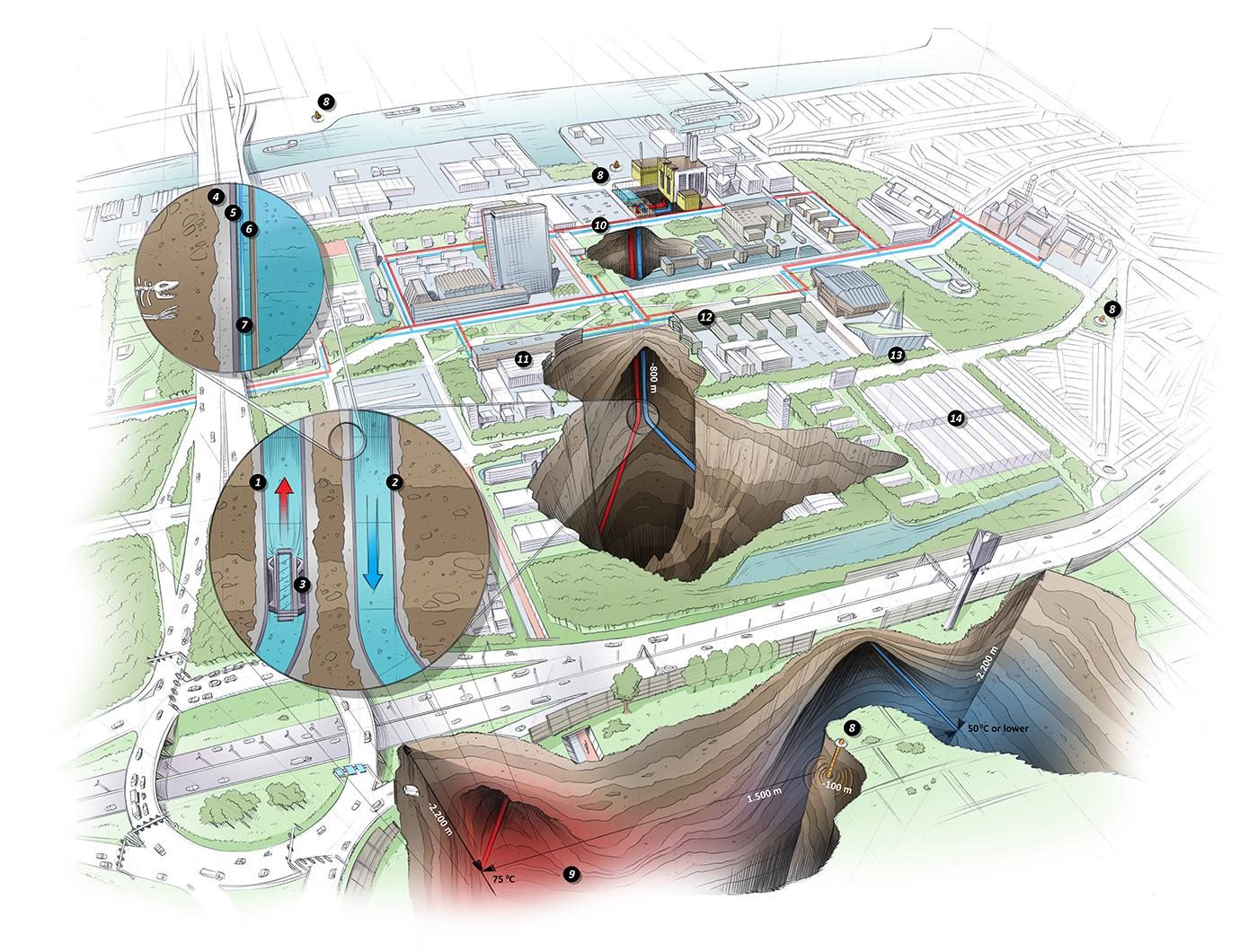
Europe is working towards climate neutrality by 2050, in line with the Paris Agreement. The subsurface is central to reaching that goal. Geoenergy uses it as a source of heat and as a storage for carbon and hydrogen. Cities and industries are replacing natural-gas heating with geothermal heat. TU Delft heats its own campus from a geothermal doublet. The Porthos project will store CO₂ captured in the Port of Rotterdam in depleted gas fields beneath the North Sea. Salt caverns will store hydrogen, as Gasunie is developing at Zuidwending, to balance supply from wind and solar.
Each of these projects needs seismologists. Before drilling, we map the historical seismicity of a site. That seismicity reveals the stresses, faults and structures that make a productive geothermal reservoir or a secure CO₂ storage. Seismic methods image the subsurface without drilling into every area of interest. Once operations start, seismologists monitor how stresses evolve. Microseismicity shows where fluids migrate and confirms whether they stay within the intended reservoir. Monitoring also anticipates induced seismicity before it is felt. Done well, it safeguards delivery of clean energy.
This workshop builds those skills. It covers the three ingredients of monitoring: a baseline catalog, an accurate P- and S-wave velocity model, and a network designed to detect and locate the events that matter.
Day 1 · Wed 12 May
Earthquake catalogs & induced seismicity
Earthquake-catalog construction and statistics, with Groningen as the reference case: two decades of extraction-induced seismicity and an open KNMI catalog. Estimate magnitude of completeness, track b-value in space and time, and apply the rate and spatial criteria used to attribute events to operations rather than tectonics.
Accurate hypocentres and focal mechanisms depend on velocity models. Velocity-model construction and subsurface imaging from active-source data, including S-wave velocities extracted from vibroseis recordings, and passive-source seismic interferometry. Site visit to DAPwell.
Sensor placement determines which microearthquakes are detected and how well they are located, yet network geometry is often overlooked. Principles of detection and location, signal-to-noise thresholds, azimuthal coverage and depth resolution, then optimal network design for a Dutch CCS or geothermal field.
Day 3 programme →DAPwell, the TU Delft campus geothermal doublet, visited on Day 2Illustration: Studio Stephan Timmers · via Bruhn et al. (2026), Sci. Dril. 35, 83–97, CC BY 4.0